Vacuum Forming vs Pressure Forming: Key Differences, Benefits, and Applications
Date: March 23rd, 2026
Choosing the right plastic forming process is important for manufacturers looking to balance cost, quality, and performance. Among the most widely used thermoforming methods are vacuum forming and pressure forming.
While both techniques involve heating a plastic sheet and shaping it over a mold, the final output can vary significantly in terms of detail, finish, strength, and application. Understanding the difference between these two methods can help businesses make informed production decisions.
What is Vacuum Forming?
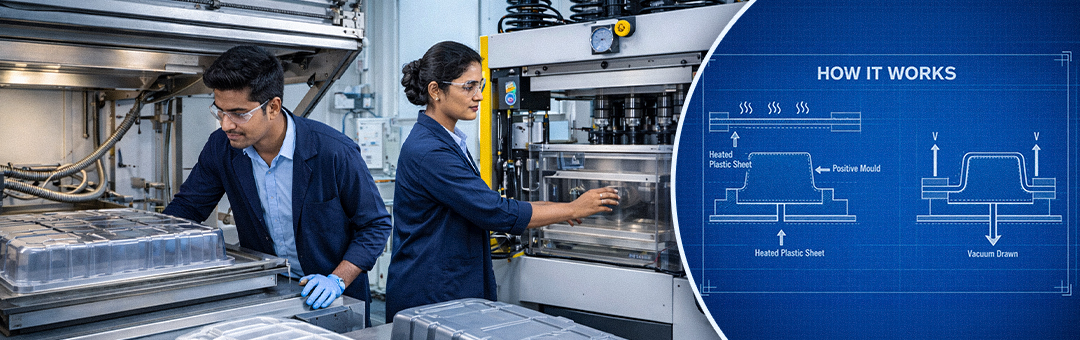
Vacuum forming is a thermoforming process in which a plastic sheet is heated until it becomes soft and flexible. The heated sheet is then placed over a mold, and air is removed from between the mold and the plastic. This vacuum pulls the material tightly against the mold surface, creating the desired shape. Once cooled, the plastic hardens and is trimmed into the final product.
This method is popular because it is simple, fast, and cost-effective. Vacuum forming is commonly used for making trays, packaging inserts, equipment covers, panels, and protective housings. It is especially suitable for large parts and designs that do not require intricate detailing.
What is Pressure Forming?
Pressure forming is an advanced version of vacuum forming. Like vacuum forming, it begins by heating a plastic sheet until it becomes pliable. However, in addition to vacuum suction, compressed air is applied from above the sheet. This added pressure forces the plastic more firmly against the mold, allowing it to capture fine details, sharper edges, and textured surfaces.
Because of this enhanced precision, pressure forming is often chosen for products that need a premium look and a more refined finish. It is widely used for medical device housings, machine covers, branded enclosures, automotive interior parts, and kiosks.
Main Difference Between Vacuum Forming and Pressure Forming
The biggest difference between these two processes is the amount of detail they can achieve. Vacuum forming relies only on suction, so it works best for relatively simple shapes and larger components. Pressure forming uses both suction and air pressure, which allows it to produce parts with crisper lines, sharper corners, and better surface definition.
In simple terms, vacuum forming is ideal when affordability and functionality are the priority, while pressure forming is better when appearance and detail matter more.
Tooling and Production Cost
One of the main reasons manufacturers choose vacuum forming is its lower tooling cost. The molds used for vacuum forming are generally simpler and less expensive to produce. This makes the process a practical option for low- to medium-volume production runs, prototypes, and custom plastic parts.
Pressure forming involves more advanced tooling and equipment because it needs to handle additional compressed air. As a result, the upfront cost is higher than vacuum forming. However, it is still more affordable than injection molding and offers an excellent middle ground for businesses that want high-quality plastic parts without the heavy investment of more complex manufacturing methods.
Finish and Visual Appeal
When it comes to aesthetics, pressure forming has a clear advantage. The extra air pressure helps the plastic sheet conform more closely to the mold, reproducing textures, logos, and intricate features with greater accuracy. This results in products that often look similar to injection-molded parts.
Vacuum formed products, while functional and durable, usually have softer edges and less refined detail. For industrial and commercial applications where appearance is not the top priority, vacuum forming remains an excellent option. But for customer-facing products or premium equipment covers, pressure forming is often preferred.
Strength and Consistency
Both vacuum forming and pressure forming can produce durable components, but part consistency may differ depending on the design. Vacuum formed parts can sometimes have uneven wall thickness because the plastic stretches over the mold. Pressure forming generally provides better material distribution in designs that require more detail or deeper draws.
This means pressure formed components may offer more consistency in performance and finish, particularly in demanding applications.
Common Applications of Vacuum Forming
Vacuum forming is commonly used in industries that need affordable and lightweight plastic parts. Typical applications include packaging trays, refrigerator liners, protective covers, display backs, and transportation inserts. It is also widely used for prototypes because of its faster turnaround and lower tooling expense.
Common Applications of Pressure Forming
Pressure forming is chosen when visual quality and precision are more important. It is frequently used in medical equipment covers, automotive dashboards, point-of-sale displays, electronic housings, and machinery enclosures. Its ability to deliver a polished and professional appearance makes it valuable in sectors where both functionality and presentation are important.
Which Process Should You Choose?
The choice between vacuum forming and pressure forming depends on several factors, including budget, production volume, design complexity, and the level of finish required. If your project needs simple, large, and cost-effective plastic parts, vacuum forming is often the better solution. If you need sharper detail, better aesthetics, and a more premium appearance, pressure forming is the stronger option.
It is always beneficial to work with an experienced manufacturer who can evaluate your product requirements and suggest the most suitable process. This is particularly important for industries that are part of larger industrial supply networks, including businesses connected to distributor transformers in India and other infrastructure-related manufacturing sectors.
Conclusion
Vacuum forming and pressure forming are both highly effective thermoforming methods, but they serve different manufacturing needs. Vacuum forming stands out for its affordability, speed, and practicality, especially for simple or large plastic components. Pressure forming, on the other hand, delivers sharper details, improved aesthetics, and a more premium finish.
Understanding these differences allows businesses to select the right process for their product goals. Whether the focus is on functionality, appearance, or production efficiency, choosing the correct forming method can improve both product quality and cost-effectiveness. As industrial manufacturing continues to evolve, these processes will remain important across many sectors, including those associated with distributor transformers in India.