October 15th, 2026
Design Techniques That Boost Distribution Transformer Longevity
A reliable electricity supply depends on equipment that can perform consistently over many years. Distribution transformers play an essential role by reducing high voltage to levels suitable for homes, commercial buildings and industrial facilities. When a transformer fails unexpectedly, it can disrupt operations, increase maintenance costs and affect the wider power network.
For every distribution transformer in India, longevity is influenced by several factors, including ambient temperatures, changing electricity demand, environmental exposure and operating conditions. While regular maintenance is essential, a transformer’s service life begins with its design. Choosing appropriate materials, managing heat effectively and incorporating reliable protection mechanisms can help prevent premature deterioration and improve long-term performance.
How Does Material Selection Improve Transformer Life?
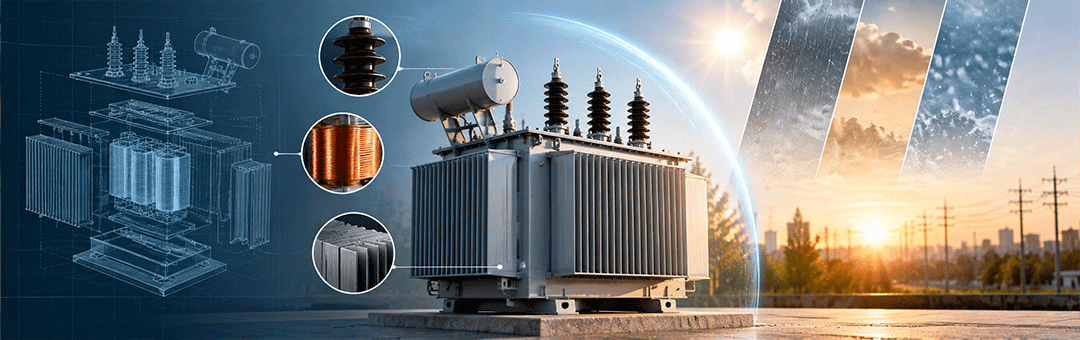
The materials used in a transformer directly affect its efficiency, strength and resistance to ageing. High-quality electrical steel helps reduce core losses, while carefully selected copper or aluminium conductors support efficient current flow. The choice between these conductors should consider the transformer’s rating, application, efficiency requirements and overall project budget.
Insulation materials are equally important. They separate electrical components and help withstand the thermal and electrical stresses experienced during operation. Insulation with suitable thermal properties can slow down deterioration caused by prolonged exposure to heat.
Core construction also matters. Precision-engineered core joints, including step-lap designs where appropriate, can reduce magnetic losses, noise and vibration. Together, these design decisions help create a transformer that operates efficiently without placing unnecessary stress on its internal components.
How Can Better Cooling Prevent Premature Transformer Failure?
Excessive heat is one of the major causes of transformer ageing. As temperatures rise, insulation deteriorates more quickly, potentially reducing the equipment’s useful life. Effective thermal management is therefore a fundamental part of transformer design.
Oil-immersed transformers use insulating oil to transfer heat away from the core and windings. Radiators, cooling fins and appropriately designed tanks increase the surface area available for heat dissipation. Depending on the transformer’s capacity and operating requirements, natural or assisted cooling arrangements may be suitable.
Designers must also consider local weather conditions and expected loading patterns. A transformer installed in a hot outdoor environment needs adequate cooling capacity to maintain safe operating temperatures. Temperature monitoring can provide an additional layer of protection by helping operators identify abnormal heating before it develops into a serious fault.
How Does Load-Based Design Extend Service Life?
A transformer must be selected according to the electrical demand it is expected to handle. If its capacity is consistently insufficient for the connected load, excessive heating and insulation stress may follow. However, selecting an unnecessarily large transformer can also increase initial costs and affect operating efficiency under certain load conditions.
Accurate load assessment helps engineers determine an appropriate kVA rating by considering peak demand, load variation and anticipated future growth. For a distribution transformer in India, this assessment is particularly useful in areas where residential expansion, commercial activity or industrial development may increase electricity consumption.
Engineers should also account for harmonics, motor-starting currents and other electrical characteristics where relevant. A design that reflects actual operating conditions is better equipped to deliver dependable performance without unnecessary thermal or electrical stress.
Which Protection Features Help Transformers Withstand Electrical Stress?
Voltage surges, short circuits, moisture and mechanical shocks can all threaten transformer reliability. Incorporating suitable protective features during the design stage helps reduce these risks and supports safer operation.
Surge arresters can help protect against transient overvoltages, while correctly specified winding clamping arrangements improve mechanical stability during short-circuit events. Depending on the transformer design, accessories such as oil-level indicators, temperature indicators and pressure-relief devices can help operators identify potentially dangerous conditions.
Outdoor installations also require attention to weather resistance. Corrosion-resistant coatings, sealed joints and suitable bushings help protect components against moisture, dust and environmental damage. These features are especially valuable when transformers are installed in exposed locations or challenging industrial environments.
Why Are Quality Testing and Standards Essential for Long-Term Reliability?
Even a well-planned design needs thorough testing before a transformer enters service. Routine tests help verify essential electrical characteristics and identify manufacturing defects, while other tests may be required according to the applicable standards, specifications and intended application.
For a distribution transformer in India, compliance with relevant Bureau of Indian Standards (BIS) requirements and applicable parts of IS 2026 helps establish a sound basis for safety, performance and reliability. Testing should cover the requirements relevant to the particular transformer rather than relying on a single general quality check.
Manufacturers should also maintain consistent quality control throughout production, from material inspection to final testing. This approach helps ensure that the finished equipment reflects the intended design and is suitable for its specified operating conditions.
How Can Smart Design Deliver Long-Term Value?
Transformer longevity is the result of several engineering decisions working together. Quality materials reduce losses, effective cooling controls temperature, appropriate capacity selection limits unnecessary stress, and protective features help guard against electrical and environmental risks. Monitoring, maintenance and testing complete this approach.
For utilities, industries and infrastructure developers, these decisions can translate into fewer unexpected interruptions, lower lifecycle costs and more dependable electricity distribution. Anand Steemet Pvt. Ltd. (ASIPL) focuses on engineering, quality control and long-term transformer performance to support diverse power distribution requirements.
Ultimately, extending transformer life begins well before installation. By prioritising sound engineering, relevant standards and application-specific design, organisations can build a stronger foundation for reliable power delivery for years to come.