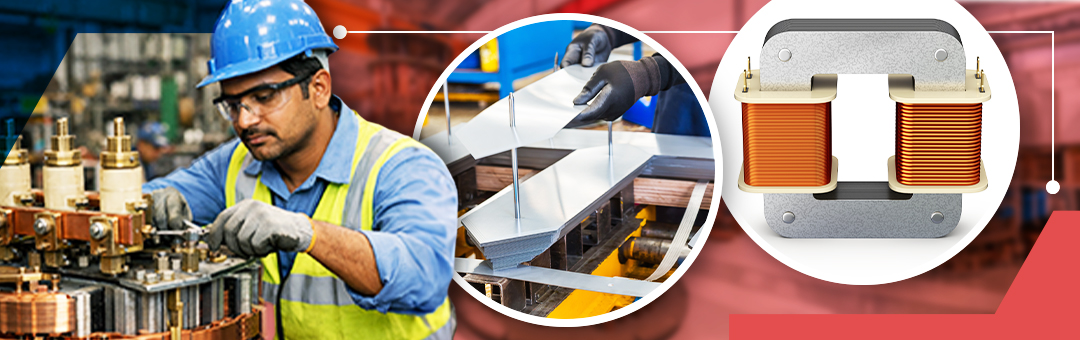
The Importance of Proper Core Building in Transformer Performance
Date: January 29th, 2026
Transformers are the silent backbone of modern power systems, enabling efficient transmission and distribution of electricity across vast distances. While windings, insulation, and cooling systems often receive attention, the core remains the heart of a transformer. Proper core building is not just a manufacturing step—it is a decisive factor that directly influences efficiency, reliability, losses, noise levels, and long-term performance.
Understanding the Role of the Transformer Core
The transformer core provides a low-reluctance magnetic path for the alternating magnetic flux generated by the primary winding. Its primary purpose is to transfer energy from the primary to the secondary winding efficiently through electromagnetic induction. A well-designed and well-built core ensures that maximum magnetic flux is utilised for power transfer rather than being wasted as losses.
In simple terms, the core determines how effectively a transformer converts electrical energy from one voltage level to another.
Core Material: The Foundation of Performance
The choice of core material is the first and most critical decision in transformer design. Most power and distribution transformers use cold-rolled grain-oriented (CRGO) silicon steel, while advanced and energy-efficient transformers increasingly adopt amorphous metal cores.
- CRGO steel offers high permeability and low hysteresis loss when properly aligned with the rolling direction.
- Amorphous metal has an even lower core loss, making it ideal for applications where energy efficiency and no-load loss reduction are priorities.
However, even the best material can underperform if core construction is poor. Material quality and core building must go hand in hand.
Importance of Accurate Core Lamination
Transformer cores are built using thin laminations rather than a solid block of metal. This design minimises eddy current losses, which are induced currents that generate unwanted heat.
Proper lamination ensures:
- Uniform thickness
- Precise cutting without burrs
- Correct insulation coating between laminations
Poor lamination quality can lead to higher losses, localised heating, and reduced transformer life. Precision in cutting and stacking is essential to maintain magnetic efficiency and thermal stability.
Flux Path Alignment and Core Assembly
One of the most overlooked aspects of core building is flux alignment. In grain-oriented steel, magnetic properties are strongest along the rolling direction. Incorrect orientation during stacking increases reluctance, leading to higher core losses and magnetising current.
Modern transformer manufacturing relies on:
- Step-lap or mitred joints to improve flux continuity
- Accurate stacking sequences to reduce air gaps
- Controlled assembly pressure to avoid mechanical stress
Even small air gaps or misalignments can significantly increase no-load losses and audible noise.
Reduction of Core Losses
Core losses are primarily divided into:
- Hysteresis loss – energy lost due to repeated magnetisation and demagnetisation
- Eddy current loss – circulating currents induced within the core material
Proper core building reduces both:
- High-quality steel lowers hysteresis loss
- Thin, well-insulated laminations reduce eddy current loss
- Tight joints and precise stacking minimise stray flux
Lower core losses translate directly into higher efficiency and lower operating costs, especially important in transformers that remain energised continuously.
Impact on Transformer Noise and Vibration
Transformer humming is largely caused by magnetostriction, the slight expansion and contraction of core material under alternating magnetic flux. Poor core construction amplifies this effect.
Well-built cores:
- Reduce mechanical vibration
- Minimise audible noise
- Improve suitability for urban, residential, and commercial installations
Inadequate clamping, uneven stacking, or mechanical stress can lead to excessive noise, complaints, and even structural fatigue over time.
Thermal Performance and Core Integrity
Heat is the enemy of transformer longevity. Excessive core losses generate heat even under no-load conditions. A properly built core ensures:
- Uniform flux distribution
- Reduced hot spots
- Lower overall operating temperature
This directly improves insulation life, prevents oil degradation, and extends transformer service life.
Long-Term Reliability and Operational Stability
Transformers are expected to operate reliably for 25–40 years or more. Core construction plays a vital role in ensuring long-term stability.
Poorly built cores may experience:
- Increased losses over time
- Mechanical loosening due to vibration
- Higher risk of insulation failure
On the other hand, precision-built cores maintain magnetic performance, mechanical integrity, and efficiency throughout the transformer’s lifecycle.
Core Building and Modern Power Demands
With the rise of renewable energy, smart grids, and fluctuating load conditions, transformers today face more dynamic operating environments. Proper core design and construction ensure:
- Stable performance under variable loads
- Compatibility with distributed energy sources
- Reduced energy wastage in idle or low-load conditions
In modern grids, even small efficiency gains at the transformer level translate into massive energy savings system-wide.
Conclusion
Proper core building is not just a technical detail—it is a strategic investment in transformer performance. From efficiency and noise reduction to thermal stability and long-term reliability, the quality of the transformer core determines how well the equipment performs throughout its life.
As energy efficiency standards tighten and power systems grow more complex, the importance of precision core construction becomes even more critical. A well-built core ensures that a transformer does what it is meant to do best: deliver reliable, efficient power—silently and consistently—for decades.
In transformer engineering, the message is clear: strong performance begins at the core.